Kynisca
An cycle tracking app made for women, by women
Client
Kynisca Innovation Hub is a non-profit organization dedicated to revolutionizing training, education, and innovation to unlock female athletic potential. Only 6% of sports science research is dedicated to female athletes and 85% of female athletes have never received education about female health. A key objective for the Kynisca team is to address this research and education gap and aim for gender parity.
Challenge
Develop a cycle tracking app centered on female athletes that can track and monitor their menstrual cycle, sleep, training, health, and wellness data – all in one place.
Only 4 months to launch for iOS and Android in time for the Paris 2024 Olympics
Create the foundation for KIH’s ultimate goal - creating the most
extensive data collection tool for female athletes to bridge the gender research gap.
Solution
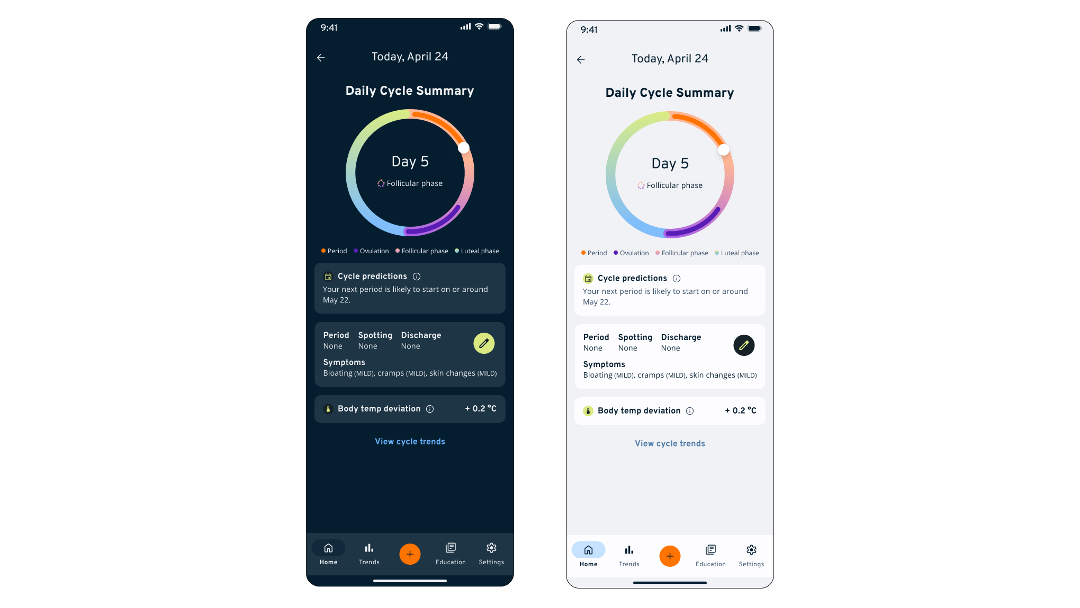
Working on a team of three female designers, we created an app experience that tackled all the client’s asks while also providing a user-friendly and design-forward interface.
Tasks & Outputs
Brand Direction
Mobile App Design
Component Library Development
Illustration
Motion Design & Interactions
User Testing
User Research
Competitive Analysis
Tools & Resources
Figma
Miro
Adobe Illustrator
Adobe AfterEffects
Storybook
Confluence
Understanding the User
While the app’s core target audience was professional female atheletes, this is a small group of users and would limit data ranges and quantities for research. We wanted to design it in such a way that any menstruating individual could leverage it to track and learn about their cycles and how they impact other aspects of their health and wellness. We determined two main personas, the Self-Driven Athlete and the Elite Athelete and gathered information of their needs and pain points.
Every menstrual cycle is different and so determining cycle and phase predictions requires a certain amount and type of data that are dependent on the user type or profile. We mapped out different user flows and potential questions and interactions throughout onboarding to determine these dependencies.
Parallel Workstreams
We had not yet been provided any branding material and had to create and get approval for our initial designs while still allowing for easy application of branding later in the process. Starting with mid- to high-fidelity wireframes using an unstyled design component kit allowed us to get more explicit feedback from our stakeholders and eventually, and also helped us create a design system library to which we could later apply styling once branding was determined.
Due to issues with finding a vendor for the app branding, I took the lead on visual design and styling direction while the app was simultaneously being designed and developed. I conducted workshops to do rapid education as well as ideation with the client team to help them make informed decisions and approvals on our branding-related proposals.
Product Launch & Iterations
We launched our app in both dark and light mode, just in time for the Summer Olympics, where the client was able to announce and present the work their organization does. After the launch, we determined post-MVP designs to create a better user experience, balancing between a research-focused app vs. one for commercial-use. We did further refinements to ensure we were striking the right tone to establish trust with the end users, through clear communication on information security and conveying Kynisca’s mission and benefits of using its apps
(I also ended up using it as my cycle-tracking app after being hesitant for so long about sharing my health data with other apps.)